Signed in as:
filler@godaddy.com
Signed in as:
filler@godaddy.com
Changing a cat’s food is not the same as changing a dog’s food.
A dog may happily inhale the new bowl because food appeared and therefore the universe is good.
A cat may sniff it, stare at you in silence, walk away, return twelve minutes later, sniff it again, and then act like you have personally betrayed generations of their ancestors.
Different management style.
The 4-Week Feline Transition Partnership is for Cat Parents who have already completed the Constitutional Analysis and want help actually putting that plan into practice.
This is the implementation side of the work.
We take the recommendations out of the Roadmap and into real life — gently, thoughtfully, and at a pace your cat can tolerate.
No forcing.
No food battles.
No pretending every cat should be fully transitioned by Day 30.
Some will be.
Some will still be negotiating.
Both can be progress.
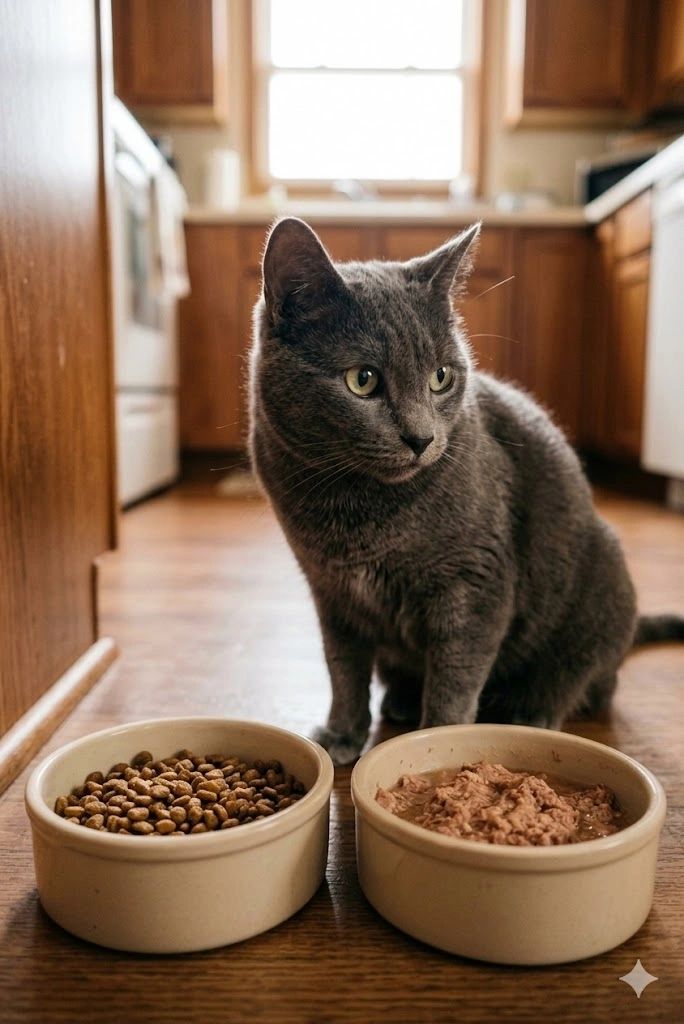

The Transition Partnership is not a stand-alone service.
It is built on your cat’s Constitutional Analysis.
That analysis gives us the bigger picture: your cat’s TCVM constitutional pattern, food and wellness considerations, routines, environment, preferences, and the other information that helps me understand the cat before we start changing things.
Without that foundation, I would be trying to personalize a transition without first understanding who I am transitioning.
And cats are far too particular for freestyle guesswork.
If you have already completed the Constitutional Analysis, you receive access to the Transition Partnership at your returning-client rate.
If you have not completed it yet, that is your first step.
One thing at a time.
Your cat would approve of the pacing.
The Constitutional Analysis tells us what deserves attention.
The Transition Partnership helps you put those recommendations into practice without turning your household into a four-week standoff.
Depending on your cat’s plan, we may be working on food, moisture, supplements, feeding routine, environmental changes, or other everyday wellness pieces identified in the analysis.
But we do not change everything at once.
That is especially important with cats.
If you switch the food, move the bowl, change the litter, introduce three supplements, relocate the water fountain, and replace the laundry detergent on the same weekend, congratulations:
You have created a mystery.
Instead, we move one piece at a time so we can actually observe what is happening.

Before we ask your cat to accept something new, we make sure the setup makes sense.
We review what you need on hand, what changes belong first, and what should wait.
If food is part of the transition, this is when you prepare the new option and decide how you are going to introduce it.
If supplements are part of the plan, we look at how to work them in without turning dinner into chemistry lab night.
If environmental or routine changes were identified in the Constitutional Analysis, we prioritize the ones that actually matter.
The goal of Week One is not to impress anyone with how much you changed.
The goal is to make the next step easier.
Cats generally prefer revolutions to happen elsewhere.

This is where we begin introducing the new food or feeding change at a pace your cat can handle.
For some cats, that may mean a tiny amount beside the current food.
For others, it may mean a small amount mixed in.
For others, the first victory may simply be allowing the new food to exist in the same ZIP code without filing a complaint.
We work with what the cat gives us.
Smell matters.
Texture matters.
Temperature matters.
Presentation matters.
And sometimes the dish itself matters because apparently the ceramic bowl committed an offense in 2023.
Fine.
We adapt.
The point is to encourage acceptance without creating food aversion, stress, or a battle over the bowl.

By Week Three, you have enough real-life information to stop guessing.
We review the patterns that are relevant to your cat and compare them with what we knew going in.
This is also where TCVM observations can help us organize what you are seeing through the broader constitutional lens.
But we are not turning every tail flick into a diagnosis.
Sometimes a cat sleeps differently because the sun moved.
Sometimes a cat vocalizes because dinner is apparently seven minutes late.
Patterns matter more than isolated moments.

The last week is about making sure the plan fits your actual household.
Not an imaginary household where everyone meal-preps on Sunday, never forgets anything, and owns matching glass storage containers.
Your household.
We review what worked, what did not, what your cat accepted, what needs more time, and what feels sustainable going forward.
If your cat is fully transitioned, great.
If they are still partway there, that does not automatically mean something went wrong.
Cats move at their own pace, especially with food.
The goal is not to force a finish line.
The goal is to leave you with a clear next step.
This deserves its own section because it is one of the biggest differences between feline and canine transitions.
Cats can develop very strong food preferences.
They can also become suspicious of sudden changes in smell, texture, temperature, location, or routine.
So I am not interested in turning mealtime into a contest of wills.
If your cat says “absolutely not,” we pay attention.
That does not mean the plan is dead.
It means we need to figure out what part of the presentation, pacing, texture, smell, or routine is getting in the way.
With cats, cooperation is usually more useful than conquest.
Also, they are better at holding grudges.


Memory is terrible.
Especially when you are trying to remember whether your cat started licking less before or after the food change, whether she drank more last week, or whether that strange litter-box day happened Tuesday or three Tuesdays ago.
The Observation Journal gives you a simple place to track the things that actually matter.
We are not recording every blink.
We are looking for patterns.
Things like appetite, digestion, stool, water intake, grooming, energy, sleep, behavior, litter-box habits, and any other observations that were specifically relevant in your cat’s Constitutional Analysis.
The journal helps us compare what you think you remember with what actually happened.
Cats already rewrite history enough.
We do not need to help them.
If supplements are part of your cat’s Constitutional Analysis recommendations, the Transition Partnership helps you introduce them in a way that makes sense.
That may mean starting one thing at a time.
It may mean changing timing.
It may mean mixing something into food — assuming your cat does not detect one microscopic grain and declare the entire meal compromised.
And if your cat has a diagnosed condition, takes medication, or there is any reason a supplement needs veterinary input, that conversation stays connected to the veterinarian.
Supplements are part of the plan when they belong there.
They are not confetti.
The Transition Partnership is not only about what lands in the bowl.
If your Constitutional Analysis identified environmental or lifestyle considerations worth addressing, this is where we start putting those into practice too.
That might include water setup, litter location, feeding location, household products, fragrance exposure, sleep spaces, movement, routine, stressors, or other everyday pieces.
But we do not turn the house upside down because one candle looked suspicious.
We focus on the things that actually seem relevant to your cat.
Holistic does not mean changing everything.
It means paying attention to the whole picture.
The Feline Transition Partnership is implementation, observation, and support.
It is not medical monitoring.
I am not diagnosing illness, changing medications, interpreting veterinary testing as a veterinarian, or deciding whether a diagnosed disease is improving or worsening.
If your cat is under veterinary care, that care continues.
And because cats can hide illness remarkably well, appetite changes, significant lethargy, urinary changes, repeated vomiting, or anything else that raises a medical concern belongs with your veterinarian.
Sometimes the next step is adjusting the transition.
Sometimes it is waiting.
Sometimes it is:
Call your vet.
All three are valid answers.
Changing a cat’s mind about dinner can feel like negotiating with a tiny judge who has already reached a verdict and is simply allowing you to present your case for entertainment.
That is where having support helps.
For four weeks, you have someone to help you think through the “What do I do now?” moments.
The hesitant sniff.
The dramatic head turn.
The sudden acceptance followed by complete rejection forty-eight hours later because apparently consistency is beneath them.
We troubleshoot the wellness and implementation side together.
You do not have to stare at the bowl alone wondering whether you should keep going, slow down, change texture, warm the food, back up a step, or simply stop hovering because your cat would like some privacy.
Cats notice hovering.
They have filed reports.

The Transition Partnership is for the Cat Parent who has already completed the Constitutional Analysis and wants help putting those recommendations into practice.
Maybe you know your cat is going to need a slower transition.
Maybe you have tried changing food before and ended up throwing away three expensive cans while your cat ate kibble behind your back.
Maybe you want accountability.
Maybe you want someone available when the plan meets actual feline opinion.
Or maybe you simply know yourself well enough to admit that the Roadmap could sit on the counter for six weeks while you promise yourself you are “starting Monday.”
No judgment.
That is why this exists.

This is not the place to start if your cat has not yet completed the Constitutional Analysis.
It is not a veterinary treatment program.
It is not a medical-monitoring service.
And it is not a promise that your cat will be fully transitioned by Day 30.
If what you want is someone to force your cat onto a new food by a deadline, Healthy Tails is probably going to frustrate you.
I am much more interested in a transition the cat can actually tolerate and sustain.
Slow can still be progress.
Cats invented slow.
The Constitutional Analysis is required before the Transition Partnership begins.
This service exists to help you implement what we already learned about your cat.
Without that assessment, there is no individualized foundation for the transition.
If you have already completed the Constitutional Analysis, you receive the returning-client rate for the Transition Partnership through the private access information included with your delivery.
If you have not completed it yet, that is the first step.
Do the homework first.
Then we negotiate with management.

At the end of the Transition Partnership, the goal is not for your cat to suddenly become easy.
Let us remain realistic.
The goal is for you to feel much more comfortable with the plan.
You will know what your cat is accepting, what still needs time, what patterns you are watching, and what you can continue on your own.
If the transition is complete, wonderful.
If it is still underway, you will know how to keep moving without feeling like you have failed some imaginary deadline.
Your cat may change later.
Preferences may change.
Health may change.
Life may change.
That is normal.
Good stewardship is not about forcing everything to stay the same.
It is about paying attention to the animal entrusted to your care and adjusting when that animal tells you something has changed.
Sometimes gently.
Sometimes through a very loud complaint at 4:12 a.m.
If your cat has already completed the Constitutional Analysis and you are ready to move from “I understand the plan” to “Okay, how do I actually do this without starting a feline labor dispute?” — this is where we begin.
We go slowly.
We watch closely.
We adjust when it makes sense.
You ask questions.
Your cat retains veto power.
And somewhere along the way, the new routine starts feeling a little less new.
We use cookies to analyze website traffic and optimize your website experience. By accepting our use of cookies, your data will be aggregated with all other user data.