Signed in as:
filler@godaddy.com
Cats are wonderfully unreasonable little creatures.
They can hear a treat bag open from three rooms away, reject the expensive food they adored yesterday, drink from the bathroom faucet while ignoring the fresh water bowl beside them, and somehow make you feel like the weird one.
I respect the commitment.
The Feline Kibble Hacker’s Guide is for Pet Parents who feed dry food and want to make the bowl more thoughtful without being told they are doing everything wrong.
Because I am not here to shame you for feeding kibble.
I am here to help you understand the cat in front of you — a moisture-loving, meat-eating little predator with very specific nutritional biology and absolutely no interest in your five-year feeding plan if dinner smells suspicious tonight.
This guide gives you practical ways to look at dry food differently, add moisture and fresh-food variety where it makes sense, and understand what is actually happening in that bowl.
No pantry bonfire required.

Cat-food packaging is very good at telling a story.
Tender chicken. Wild salmon. Ancient instincts. Indoor vitality. Possibly a majestic feline staring dramatically into the wilderness despite having never left the screened porch.
Lovely.
Now turn the bag around.
The ingredient list and nutritional panel tell us a different kind of story.
I show you how to look at the overall formula rather than getting hypnotized by one glamorous ingredient on the front or terrified by one unfamiliar word on the back.
We look at things like protein sources, fat sources, carbohydrate-heavy ingredients, calorie density, and the overall role the food is playing in your cat’s diet.
The goal is not to find a bag with a morally perfect ingredient list.
The goal is to understand the food well enough to make a more informed choice.
The Carb Hacker
Cats are obligate carnivores.
That matters.
It does not mean we need to run screaming from every carbohydrate molecule as though rice has personally insulted the family.
But dry foods require processing and structure, which means carbohydrates often play a larger role than many Pet Parents realize.
The guide shows you how to estimate the carbohydrate content of a dry food using the information available on the label and how to look at the sources contributing to it.
I am not giving you a magic number that every cat on Earth must obey.
I am helping you understand what is actually in the food so you can look at the whole bowl with better information.
Because “grain-free” does not automatically mean “low carbohydrate,” and “contains peas” does not automatically mean the food is terrible.
Context matters.
Cats remain unimpressed by marketing terminology.
We should probably follow their lead.
This is where the feline version of Kibble Hacker really separates itself from the canine one.
Cats evolved getting much of their water through prey, and many cats do not compensate for a dry diet by marching over to the water bowl and drinking enough to make everything even.
They are cats.
Compensation would imply cooperation.
So moisture deserves real attention.
The guide shows you practical ways to increase moisture around a kibble-based feeding routine without assuming that your cat will immediately agree to soup for dinner.
That might mean adding moisture gradually, incorporating appropriate wet or fresh foods, experimenting with texture and temperature, or simply making water more interesting and accessible around the house.
Because sometimes the theoretically perfect idea is useless if the cat refuses to acknowledge its existence.
Your Cat Gets a Vote
This deserves its own section because cats are not tiny Labradors.
A dog may enthusiastically accept your exciting new food plan because you appear pleased about it.
A cat may sniff it, stare directly into your soul, and leave.
Food acceptance matters.
Smell matters.
Texture matters.
Temperature matters.
Bowl shape can matter.
Location can matter.
Routine can matter.
And abrupt food changes can turn a perfectly reasonable nutritional idea into a hunger strike nobody asked for.
So the Feline Kibble Hacker’s Guide does not approach bowl upgrades like a demolition project.
We work with the cat.
Which is good practice, because the cat was going to insist on that arrangement anyway.
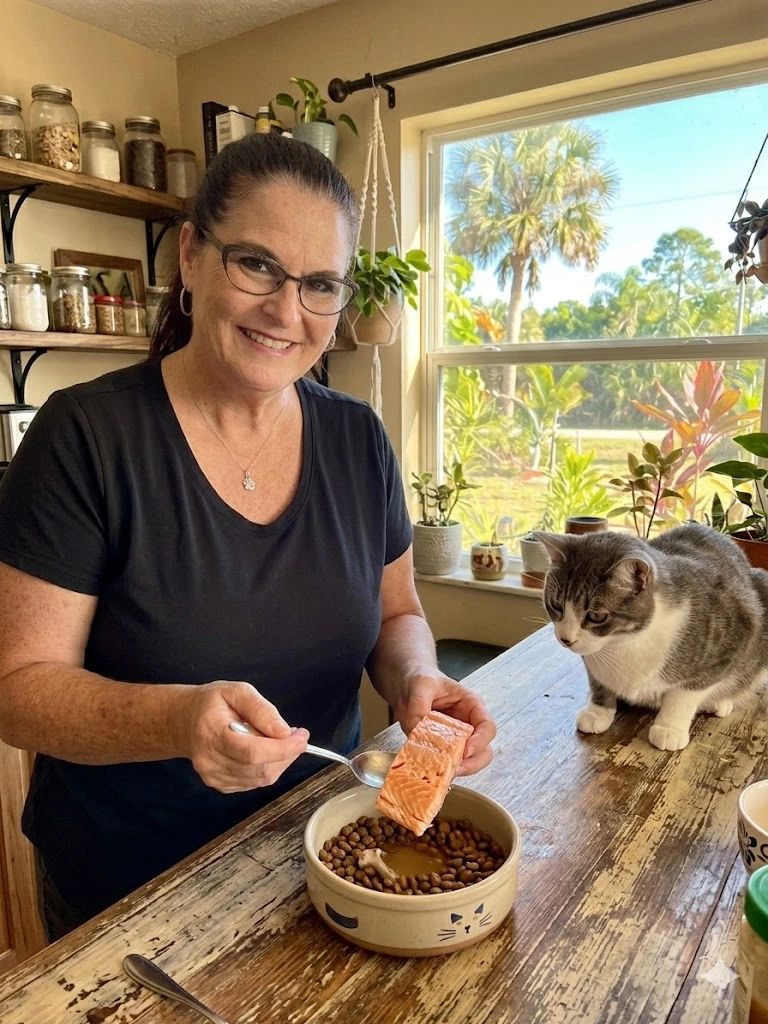
Adding fresh food to kibble can be a great way to introduce moisture, variety, texture, and whole-food ingredients.
But “fresh” does not automatically mean “throw random things from the refrigerator into the cat bowl.”
Cats have specific nutritional requirements.
So the goal is to add thoughtfully.
The guide walks you through simple bowl additions and how to think about them as part of the overall diet rather than as decorative little health confetti.
You do not need twelve powders, three oils, goat milk from a mountain monastery, and something called “ancestral glandular dust” to prove you love your cat.
Sometimes simpler is better.
Especially when the person eating dinner weighs eleven pounds and believes parsley is a personal attack.
Fresh Additions Still Count
One of the easiest mistakes to make with toppers and fresh additions is forgetting that they still contain calories and nutrients.
A spoonful here.
A little fish there.
A treat because your cat looked especially betrayed.
Another treat because now you feel guilty.
Suddenly the “tiny addition” is doing considerably more nutritional work than anyone intended.
The guide helps you think about additions as part of the whole bowl so you can make changes intentionally rather than accidentally building a second diet on top of the first one.
General education can help you make smarter additions.
If you want a complete fresh-food plan formulated specifically for your individual cat, that is a deeper service.
Different bowl.
Different homework.

Your cat is not a broken appliance.
And I refuse to build a nutrition philosophy around the idea that every bowl needs to be repaired by somebody on the internet.
The Feline Kibble Hacker’s Guide is about making thoughtful improvements where they fit.
Holistic nutrition does not require drama.
It requires paying attention to the whole animal.
That is part of caring well for the creatures entrusted to us — noticing what they need, using the information we have, and making thoughtful choices without turning dinner into an ideological purity contest.

This guide is for the Cat Parent who feeds kibble — exclusively or as part of a mixed feeding routine — and wants to understand how to make that bowl more feline-friendly.
Maybe you want to add moisture but your cat thinks wet food is suspicious.
Maybe you want to understand carbohydrates without earning a second degree.
Maybe you want to add fresh foods but have no desire to accidentally unbalance the entire diet.
Maybe you are simply tired of being told that the answer to every cat-food question is “stop feeding kibble.”
You are in the right place.
This is practical education.
No shame.
No feeding-team jersey required.
The Feline Kibble Hacker’s Guide is not a custom nutrition plan for your individual cat.
It does not formulate a fresh-food recipe, identify your cat’s TCVM constitution, create an individualized supplement program, or replace veterinary nutrition or medical care.
It teaches you how to think more critically about the food and make general improvements thoughtfully.
If your cat has a diagnosed medical condition, prescription diet, significant appetite change, unexplained weight loss, urinary signs, vomiting, ongoing diarrhea, or anything else that has moved beyond “I would like to improve the bowl,” that is a veterinary conversation first.
Cats are remarkably good at hiding illness.
That particular talent is impressive and profoundly unhelpful.