Signed in as:
filler@godaddy.com
You have seen the beautiful farm photos, the glossy promises, the roasted meat, the blueberries, and the dog on the front who appears to have recently completed a very wholesome hike.
Marketing is very good at its job.
I know because I spent more than thirty years working in advertising and marketing before Healthy Tails ever existed.
The front of the bag is designed to tell you a story. The Brand & Bag Investigation is where I turn it around and start asking whether the information on the back tells the same one.
I dig into the specific dog food you are feeding or considering and look at the ingredients, available nutritional information, estimated carbohydrate content, manufacturer, sourcing information where available, recall history, company transparency, and the claims being made about the formula.
Then I translate all of that nerdy information into normal-human language and explain how I look at the food through a holistic canine nutrition lens.
This is not about deciding whether you are a good or bad Pet Parent based on the bag in your pantry.
It is about understanding what your dog is actually eating.
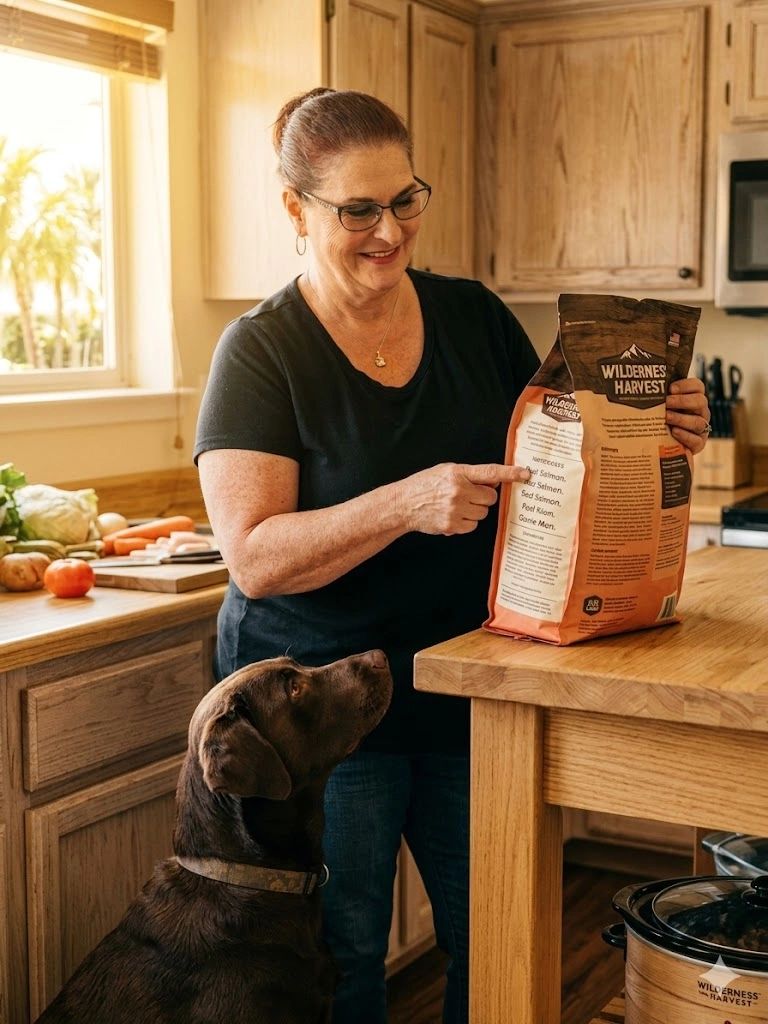

Dog-food labels do not usually give you a simple carbohydrate percentage, so I estimate it from the available numbers and look at where those carbohydrates appear to be coming from.
Then I explain the result in context.
I am not going to tell you carbohydrates are automatically “good” or “bad.” That kind of black-and-white thinking is exact
Dog-food labels do not usually give you a simple carbohydrate percentage, so I estimate it from the available numbers and look at where those carbohydrates appear to be coming from.
Then I explain the result in context.
I am not going to tell you carbohydrates are automatically “good” or “bad.” That kind of black-and-white thinking is exactly what I try to avoid.
I want to know what the carbohydrate sources are, how much appears to be there, what role they play in the formula, and what that means from a holistic canine nutrition standpoint.
One number is never the whole story.
Who actually makes the food?
That sounds like it should be an easy question.
Sometimes it is.
Sometimes we need snacks.
I review the company’s publicly available manufacturing information, recall history, and safety records so you can see who is behind the product and what has happened in the past.
A recall does not automatically mean a compan
Who actually makes the food?
That sounds like it should be an easy question.
Sometimes it is.
Sometimes we need snacks.
I review the company’s publicly available manufacturing information, recall history, and safety records so you can see who is behind the product and what has happened in the past.
A recall does not automatically mean a company is terrible, just as “no recalls” does not automatically prove perfection.
I want to know what happened, how broad the issue was, how the company responded, and whether anything in the history deserves a closer look.
The goal is not panic.
The goal is context.
This is where thirty-plus years in marketing earns its keep.
I compare the story on the front of the bag with the ingredient list, nutritional information, and company disclosures on the back.
Maybe a featured ingredient plays a meaningful role in the formula. Maybe it is sitting much farther down the ingredient list than the front of the b
This is where thirty-plus years in marketing earns its keep.
I compare the story on the front of the bag with the ingredient list, nutritional information, and company disclosures on the back.
Maybe a featured ingredient plays a meaningful role in the formula. Maybe it is sitting much farther down the ingredient list than the front of the bag might lead you to believe. Maybe a phrase sounds impressive until we look at what it actually means.
I also look at vague ingredient descriptions, additives, vitamin and mineral sources, label claims, and places where I think a Pet Parent would benefit from asking another question.
But a “red flag” does not mean I found one ingredient I dislike and therefore the entire food belongs in the trash.
It means:
That is much more useful than fear.
Once I have looked at the facts of the formula, I step back and evaluate the food through my holistic canine nutrition lens.
That means I may look at things like overall ingredient pattern, protein sources, fat sources, carbohydrate sources, processing, food variety, and how the formula fits with the kind of feeding approach you are trying
Once I have looked at the facts of the formula, I step back and evaluate the food through my holistic canine nutrition lens.
That means I may look at things like overall ingredient pattern, protein sources, fat sources, carbohydrate sources, processing, food variety, and how the formula fits with the kind of feeding approach you are trying to create for your dog.
I will tell you what I like.
I will tell you where I pause.
I will tell you where the information is incomplete.
And I will tell you when something is simply my professional preference rather than a universal rule.
What I will not do in a standard Brand & Bag Investigation is pretend I have assessed your dog’s TCVM constitution when I have not.
I know.
That is usually the question hiding underneath everything else.
Unfortunately, dog food refuses to divide itself neatly into two piles marked GOOD and BAD.
A food can have things I really like and things I would rather see done differently.
A company can make one formula I think is thoughtful and another that leaves me scratching my
I know.
That is usually the question hiding underneath everything else.
Unfortunately, dog food refuses to divide itself neatly into two piles marked GOOD and BAD.
A food can have things I really like and things I would rather see done differently.
A company can make one formula I think is thoughtful and another that leaves me scratching my head.
A food I would not personally choose first may still make sense for a particular dog, household, budget, or situation.
And a gorgeous formula on paper is not automatically the right choice for every dog.
So I am not going to hand you a morality grade for the bag.
I am going to give you the information and my holistic interpretation of it.
Then you decide what makes sense for your dog.
If your veterinarian prescribed a food for a medical reason, this investigation does not override that recommendation.
I can still help you understand what is in the product, what the label tells us, and what questions you may want to ask your veterinarian about it.
But I am not going to tell you to stop feeding a veterinary diet because I
If your veterinarian prescribed a food for a medical reason, this investigation does not override that recommendation.
I can still help you understand what is in the product, what the label tells us, and what questions you may want to ask your veterinarian about it.
But I am not going to tell you to stop feeding a veterinary diet because I dislike one ingredient.
The medical reason for the diet matters.
That part belongs with the veterinarian overseeing your dog’s care.
Healthy Tails can help you understand the food without pretending the food exists separately from the dog’s medical picture.

This is not a quick glance at an ingredient list.
I do the digging and give you a complete report on the specific dog food you asked me to investigate.
Your report pulls together the ingredients, available nutritional information, estimated carbohydrate content, company and manufacturing information, recall history, marketing claims, areas I think deserve a closer look, and my holistic canine take on the formula.
I will also separate what we can verify from what we cannot.
Because “the company does not disclose this” is useful information too.
By the end, you should understand the food much better than you did when we started. You will know what I like, what makes me pause, what questions remain, and what information matters most as you decide whether that food belongs in your dog’s bowl.
Not total certainty.
Better information.
I’ll take that trade every time.